

This calculator has been reviewed and approved by Dr. Magdy Ashour, former Scientific Advisor to the Grand Mufti of the Arab Republic of Egypt.
What is the Zakat Calculator?
The Zakat Calculator is a tool that helps you calculate your zakat easily and accurately. It covers all common types of assets and calculates the zakat due based on the current Al-Nissab.
How to access the calculator
- Open Thndr App
- Tap on ‘My Hub’
- Under ‘Investment services’ find ‘Zakat Calculator’
How to use the calculator
- Choose the year type
When you open the calculator, select the year type on which you want to calculate your zakat:
- Hijri year: Zakat rate is 2.5%
- Milady year: Zakat rate is 2.577%
- Enter your assets
Enter the value of each asset type in its designated section. You can add multiple entries under each asset category.
- Calculate zakat
After entering all your assets, tap on “Calculate Zakat” to view the result.
Al-Nissab
Al-Nissab is the minimum threshold of wealth upon which zakat becomes obligatory.
- Gold Nissab: 85 grams of 21-karat gold
- Silver Nissab: 595 grams of commonly traded silver (925 purity) – used only if you own silver exclusively
The current Nisab is updated according to the current price of gold.
Setting Your Hawl start Date (New!)
You can now specify the exact date your Hawl started (when you reached the Nisab). Tap on the Nisab date displayed in the calculator to customize it. This allows you to calculate Zakat for any past year, not just the current one.
Important – Hawl Year Calculation: If your wealth drops below the Nisab at any point, the Hawl year starts counting again from when your wealth reaches Nisab. This means you must not drop below the Nisab for a full continuous year for Zakat to be obligatory.
Details of zakat calculation for each asset type
- Cash and bank balances
Includes cash on hand, savings accounts, and current accounts.
Adopted Sharia opinion: Zakat is due in full.
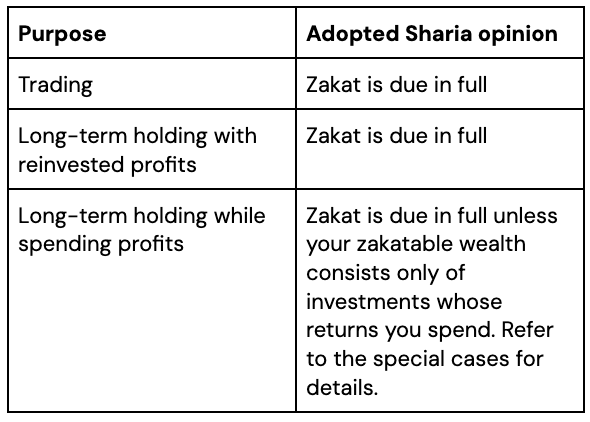
- Stocks and funds
Includes shares, mutual funds, and ETFs.
Adopted sharia opinion: Zakat is due in full on the current market value.
Cases:
3. Bank certificates
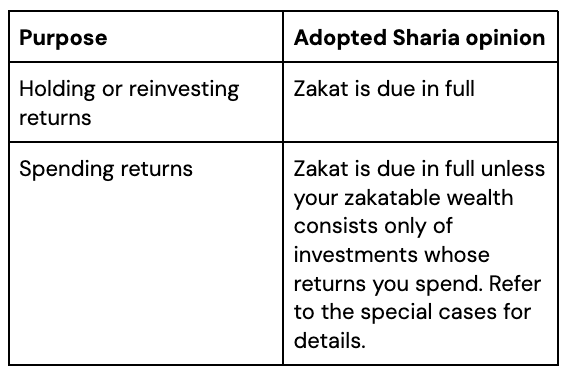
Includes bank certificates of deposit.
Adopted sharia opinion: Zakat is due in full on the total value.
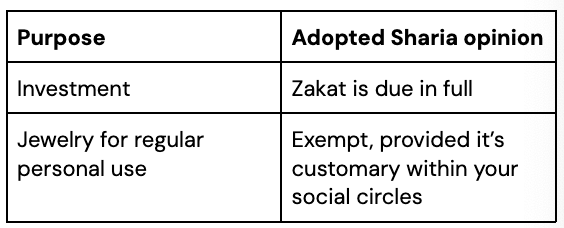
4. Physical gold
Includes gold bars, gold coins, and jewelry.
Note: Gold investment funds are calculated under the Stocks and Funds section.
Cases:
Supported purities: 24K, 21K, 18K, 14K
5. Physical silver
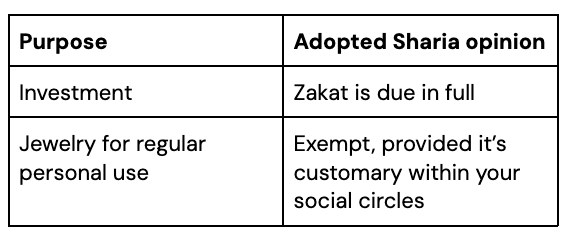
Includes silver bars, silver coins, and jewelry.
Cases:
Supported purities: 999, 925
Note: If you enter the price of one purity, the price of the other purity is calculated automatically.
6. Real estate
Includes land, apartments, houses, and commercial properties.
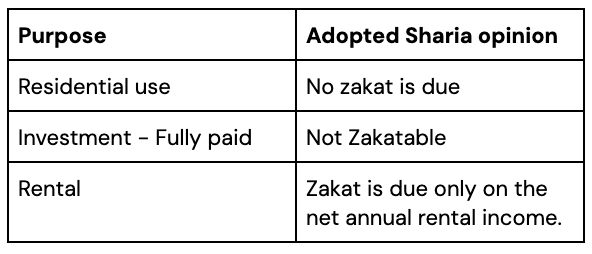
*If an investment unit has standing installments, only the paid amount is zakatable (do not include the remaining installments in Debts).
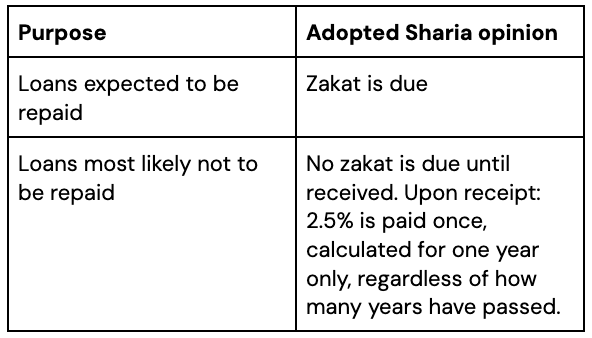
7. Money lent to others
Includes money you have lent to family, friends, or others.
Cases:
8. Commercial assets (trade goods)
Includes inventory held for sale and receivables.
Adopted sharia opinion: Zakat is due in full.
Note: Fixed assets (buildings, equipment, business vehicles, manufacturing tools) are not subject to zakat.
9. Debts (amounts you owe)
Includes amounts due within the upcoming zakat year and any installments payable.
Adopted sharia opinion: these are deducted from your total zakatable wealth.
Special cases
1. Spending profits or returns only
If your zakatable wealth consists only of investments or certificates whose returns you spend (with no other zakatable assets):
- No annual zakat is due.
- Alternative: In this case, it is permissible to pay 10% of the return only as Zakat, and a lunar year (Hawl) is not required to pass on the principal amount.
Note: If you own other zakatable assets, these investments or certificates are included in the regular calculation at 2.5%.
2. Owning silver only
If you own silver only (with no other zakatable assets), the silver Nissab (595 grams of 925 silver) is used instead of the gold Nissab.
When using the silver Nissab:
- If you reached the gold Nissab as well, zakat is obligatory in all cases.
- If you are below the gold Nissab, you may choose which Nissab to follow.
3. Owning real estate investments only
If your zakatable wealth consists only of real estate investments (with no other zakatable assets):
- No annual zakat is due.
- Alternative: Upon sale, 2.5% of the sale price is due as zakat if one lunar year (Hawl) has passed, calculated for one year only, regardless of how many years have passed.
4. Loans most likely not to be repaid
Loans that are highly unlikely to be recovered are not included in the annual zakat calculation. Upon receiving the amount, 2.5% zakat is due for one year only, regardless of how many years have passed.
5. Below Al-Nissab, but doubtful Loans push you to reach it
If your confirmed wealth is below Al-Nissab, but adding loans that are highly unlikely to be recovered would push you to reach Al-Nissab:
- You are not obligated to pay zakat at this time.
- The calculator will show you the “Potential Zakat Amount” that would become due if those loans are repaid.
- Keep this information for your records.
Important notes
- This calculator covers general and common cases. Please consult a qualified scholar for specific rulings.
- It is preferable to calculate zakat according to the Hijri year. However, if a Muslim needs to calculate according to the Gregorian year, there is no sin in doing so.
- Zakat is paid once per asset. Please select the correct purpose and do not enter the same asset twice.
- Your wealth must remain reaching the Nisab for one full continuous year. If it drops below Nisab at any point, the year resets when your wealth reaches Nisab again.
For the full Zakat methodology used click here.

