Twice a year, a deposit lands in your brokerage account. You didn’t sell anything. You didn’t time a trade. You just held and the companies inside your portfolio decided to share their profits with you.
That’s what a dividend ETF does. And there’s one on ADX right now: the Chimera Solactive GCC Shariah Dividend ETF, ticker GCCDIV, that holds around 20 of the Gulf’s biggest dividend-paying companies, Shariah-screened, and passes their cash straight to you.
If that sounds straightforward, it is. Here’s everything you need to know.
First: what’s an ETF?
An ETF — exchange-traded fund — is a single security that holds a basket of stocks inside it. You buy one thing on the exchange, and you get exposure to everything it contains. It trades during market hours with a live price, just like any individual share. You can buy as little as one unit.
Think of it as a ready-made portfolio that someone else built and maintains, packaged into a single ticker you can buy and sell on ADX like any other stock. The fund follows a set of rules (an index) that decide which companies get in and which don’t. It’s not a person picking stocks based on a feeling — it’s a transparent, rules-based system.
GCCDIV is that kind of product. It tracks the Solactive GCC Shariah Dividend Index, which holds around 20 companies at any given time.
What’s actually inside it?
This is probably the best part: you already know many of these companies.
du — the telecom you probably use every day if you live in the UAE. Air Arabia — the airline you’ve likely flown. Borouge — one of the largest companies on the Abu Dhabi Stock Exchange (ADX), a major petrochemicals player that’s paid over USD 4 billion to shareholders since its 2022 IPO. Jarir Marketing — the Saudi retail and bookstore chain. Industries Qatar, WOQOD (Qatar’s fuel company), Yansab, Barwa Real Estate, Sharjah Islamic Bank.
These nine are the named holdings across the fund’s documents. The total is 20 companies, spanning the UAE, Saudi Arabia and Qatar — with the design to potentially expand to other Gulf markets over time.
Dividend yield by holding
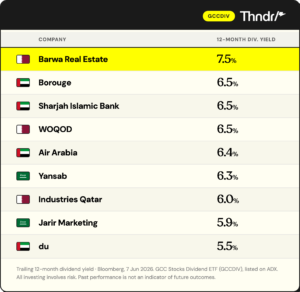
What’s striking is how consistently they all pay. Each of these companies individually yields somewhere between roughly 5.5% and 7.5% per year in dividends. There’s no single outlier inflating the average — the whole basket earns its keep. This is historic information which provides an indication but no guarantee of future performance. Dividends are paid at the discretion of the boards of each of the underlying companies.
How does it actually pay you?
GCCDIV is a distributing ETF. That means the dividends it collects from its 20 holdings get pooled and paid out to you in cash, twice a year.
This is income, not interest. It’s real money that real, profitable companies decided to give back to their shareholders. The index’s trailing 12-month dividend yield is about 6.2% before fees — or roughly 5.7% after the fund’s 0.50% annual cost.
How does it decide which 20 companies make the cut?
This is where it gets interesting. The index doesn’t just grab the 20 stocks with the highest dividend yield in the Gulf and call it a day. High yield alone can be a warning sign — a stock might yield 10% because its price collapsed, not because the company is healthy.
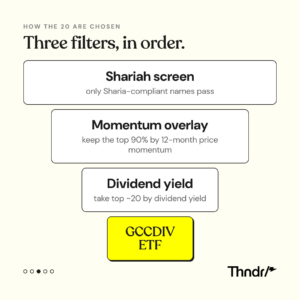
Instead, it runs a three-step filter in a specific order:
Step 1 — Shariah screen. Every company in the Gulf-listed universe is checked for Shariah compliance by an independent screening firm (Ideal Rating). Only compliant companies pass to the next stage. This isn’t a label bolted on at the end — it’s the gate.
Step 2 — Momentum filter. The compliant companies are ranked by their 12-month price performance. The bottom 10% are removed. This quietly drops the weakest performers before yield is even considered — you’re not buying companies that are cheap because they’re falling apart.
Step 3 — Dividend yield. Only now does the index rank by dividend yield and select the top ~20. There’s a buffer rule to avoid unnecessary churn: the top 15 by yield are always included, and existing holdings ranked 16–25 stay in until the count reaches 20.
The result: Shariah-compliant, financially healthier, genuinely high-yielding — rebalanced once a year. One way to think about it: it filters for faith, then quality, then income.
What does it cost?
The fund charges a total expense ratio (TER) of 0.50% per year. That’s a single fee covering management and administration — there are no separate subscription or redemption charges when you buy or sell on ADX. You pay your regular brokerage commission, and that’s it.
Who runs it?
The investment manager is Lunate Capital, an Abu Dhabi-based asset manager with more than USD 115 billion under management. The fund is under the custody of BNY Mellon, audited by Deloitte, with the index built by Solactive and legal advice from Norton Rose Fulbright. It’s regulated by the UAE Capital Market Authority (CMA) and listed on ADX.
The Shariah compliance is certified by a fatwa from Dar Al Sharia, signed by Professor Dr. Mohammad Abdul Rahim Sultan Al Olama, Chairman of the Sharia Supervisory Committee.
What about the track record?
The index’s back-tested history shows an annualised total return of about 11.5% over nine years — meaning roughly half came from dividend income and half from share-price appreciation.
A genuine caveat worth stating clearly: the index only went live in June 2025. Almost all of that nine-year history is back-tested data — a simulation of what would have happened if these rules had been applied historically. It’s useful for understanding the strategy, but it’s not a record of real money being managed. Past performance, especially simulated performance, doesn’t guarantee what happens next.
Where do the sectors fall?
The Shariah screen naturally shapes the sector mix. Conventional banks are largely excluded (financials make up only about 4.8% of the index — the one bank in the book is Sharjah Islamic Bank). Instead, the basket tilts toward materials (25.8%), industrials (21.0%) and energy (12.6%), with meaningful exposure to telecoms, consumer and real estate.
That tilt is part of what gives the fund its income-and-growth character. These aren’t sleepy utility stocks paying a coupon — they’re companies operating in sectors tied to the Gulf’s infrastructure build-out, energy transition and consumption growth.
How do I buy it before it is listed on the market?
How to subscribe during the initial offering
Before GCCDIV starts trading on ADX, there’s a window to subscribe at a fixed price — called the Initial Offering Period (IOP). Think of it as a first-access window before the ETF goes live on the exchange, and you can get in on it directly through Thndr.
Here are the key details:
- When: June 8–16, 2026.
- Price: AED 3.67 per unit + AED 0.04 issuance fee = AED 3.71 all-in.
- Minimum subscription: AED 5,000.
- Listing date: June 23, 2026 — after which it trades on ADX like any stock.
How it works through Thndr. You should have received an email with instructions on how to subscribe. Fill in the order form attached in the email with the amount you’d like to subscribe for — only your last submission counts if you change your mind. Your order won’t appear in the app (this is a manual process on our side), but the full amount will be blocked in your wallet once confirmed. Make sure you have the balance ready; if it’s short, we’ll let you know so you can top up or free up funds. Need to cancel? Use the cancellation form — also in the email. Just note that cancelling removes your entire order, so you’d need to resubmit the order form if you want back in.
A couple of things worth knowing. Thndr’s order deadline is two days before the ADX-announced end date to allow time for processing, so don’t wait until the last day. And unlike a typical IPO where oversubscription can mean you only get a fraction of what you asked for, ETF IOPs are open-ended — your requested amount will most likely be fully allocated, except for any fractional units.
After the subscription closes, you’ll get a confirmation with your order details. Once the ETF lists on June 23, your units are in your Thndr app and you can hold for dividends or trade them on ADX whenever you like.
How do I buy it after it is listed on the market?
GCCDIV trades on ADX like any listed share. You can buy as little as one unit — there’s no minimum investment on the secondary market beyond the price of a single share. You buy it, hold it, collect the dividends. If you want out, you sell it any workday during market hours.
The bottom line
GCCDIV packages something that used to require a lot of research, multiple accounts and significant capital — owning a diversified basket of the Gulf’s highest-paying, Shariah-compliant dividend stocks — into a single ticker on ADX. It won’t make you rich overnight. It’s not designed to. It’s designed to pay you, consistently, from the profits of companies you already know and interact with.
If you’ve been investing stock by stock and wondering whether there’s a simpler way to build income in your portfolio, this is worth understanding.
Additional resources
This article is for information only and is not financial advice or a recommendation to buy or sell any security. Capital is at risk; the value of investments can go down as well as up. Index performance shown is largely back-tested and hypothetical; past performance is not indicative of future results. Dividends are paid when available. The fund carries a 0.50% total expense ratio. Consider your own circumstances and seek independent advice before investing.