In the first half of 2026, Misr Life Insurance made EGP 1.9 billion from selling insurance. It made more than four times that, EGP 8 billion, from investing.
That one fact explains most of this IPO. Misr Life is Egypt’s largest life insurer, 126 years old, with 4.35 million customers. It is also one of the biggest investors in the country, with EGP 101 billion in bonds, shares, deposits and property. Until now, you couldn’t own a piece of either.
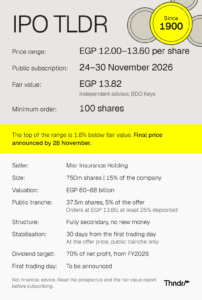
That changes this week. Misr Insurance Holding, which is owned by the Sovereign Fund of Egypt, is selling 750 million shares, or 15% of Misr Life, at EGP 12.00 to 13.60 a share. That values the company at EGP 60 to 68 billion and the sale at EGP 9.0 to 10.2 billion. Retail gets just 5% of the offer, and the public window runs 24 to 30 November.
The number some people might miss
The independent financial advisor, BDO Keys, valued Misr Life at EGP 13.82 a share. At the top of the range, EGP 13.60, you’re getting a 1.6% discount to that. At the bottom, EGP 12.00, the discount is 13.2%. For comparison, Banque du Caire’s range topped out exactly at fair value, and MNT-Halan came in at a 5.5% discount.
At EGP 13.60 you’re paying about 1.3x book value, and 6.6x first-half 2026 earnings if you double them for a full year. The prospectus puts the sector at 1.8x book and 10.4x earnings. The final price comes out by Saturday 28 November, two days before the public window closes.
What Misr Life does
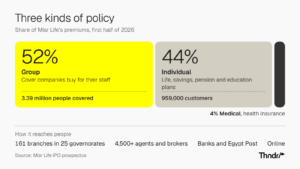
It sells life insurance and long-term savings policies, then invests the money until it has to pay out. Its premiums come from three types of business (first half of 2026):
- Group policies (52% of premiums): life and savings cover that companies buy for their staff. About 3.39 million of its 4.35 million customers are covered this way.
- Individual policies (44%): life cover, savings and investment plans, pensions (including “Bokra” pension plans in both pounds and dollars), education and marriage plans, and cancer cover.
- Medical (4%): a small health insurance line.
It sells through 161 branches in 25 governorates, more than 4,500 agents and brokers, banks, Egypt Post, and online. It also reinsures other insurers’ life business and runs two of its own investment funds.
Under FRA statistics for 2023/24, Misr Life wrote 32.7% of Egypt’s net life insurance premiums and managed 48.1% of all the money invested by the life insurance sector. That second number explains the business better than the first.
How Misr Life makes money
Two ways. The first is insurance: collect premiums, pay claims and costs, keep what’s left. The second, and much bigger, is investing. Policyholders hand over money that often won’t be paid out for decades, and Misr Life invests it in the meantime. On top of that, it invests its shareholders’ own money.
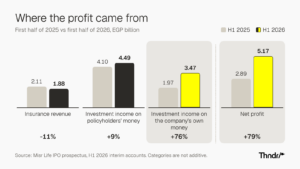
That’s the split behind the number at the top of this post. In the first half of 2026, insurance revenue was EGP 1.9 billion. Investment income on the money set aside for policyholders was EGP 4.5 billion, and investment income on the company’s own funds was another EGP 3.5 billion.
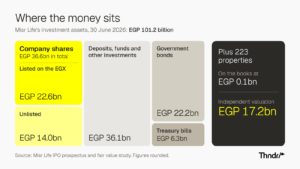
By June 2026, the company had EGP 101.2 billion in investment assets, up 15% in six months. Roughly:
- EGP 28.5bn in government bonds and treasury bills
- EGP 36.6bn in company shares, EGP 22.6bn listed on the EGX and EGP 14.0bn unlisted, spread across stakes in more than 110 companies
- Bank deposits in pounds and foreign currency, investment funds, and 223 properties
So when you buy Misr Life, you are buying an insurer and also one of the biggest investment portfolios in Egypt.
The numbers
| EGP mn | FY2024 | FY2025 | H1-2025 | H1-2026 |
| Total revenue | 17,219 | 17,466 | — | 10,588 |
| Profit before tax | 7,185 | 6,904 | 3,520 | 5,905 |
| Net profit | 6,092 | 5,756 | 2,885 | 5,168 |
| Shareholders’ equity (bn) | 34.3 | 44.0 | — | 52.1 |
| Earnings per share (after staff share) | 1.15 | 1.07 | — | 1.03 |
Source: Misr Life IPO prospectus. Earnings per share are restated for the 10-for-1 share split in October 2026.
Three things stand out.
- First-half profit jumped 79%. Net profit went from EGP 2.9bn to EGP 5.2bn, almost as much as the whole of 2025.
- That jump came from investments, not from selling more insurance. Income on the company’s own investments rose from EGP 2.0bn to EGP 3.5bn, and other income rose by about EGP 0.4bn. Insurance revenue actually fell 11%. In 2025, profit fell 5.5%.
- Only two and a half years are comparable. Misr Life switched to the new insurance accounting standard (EAS 50) from 2024 and changed its financial year from June to December. The prospectus says there is no comparable 2023 income statement, so you can’t see a longer trend.
The advisor’s forecast has profit at about EGP 9.7bn for 2026, EGP 11.4bn in 2027 and EGP 17.8bn by 2030, about 16% a year from 2027.
What’s genuinely strong here
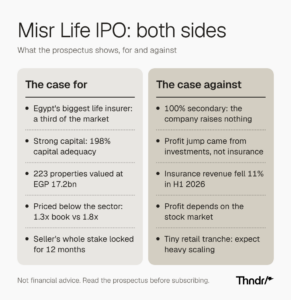
It’s the market leader by a distance. A third of Egypt’s net life premiums and almost half the sector’s invested money. Scale matters in insurance: more policies spread the risk, and a bigger portfolio spreads the costs.
A distribution network that’s hard to copy. 161 branches, 4,500+ agents, bank and post office partnerships, and employers who sign up thousands of staff at once.
Very strong capital. The capital adequacy ratio is 198% under international standards, and the solvency margin under FRA rules is 926%. The company can absorb a lot before it needs to raise money.
Property worth far more than its book value. Misr Life owns 223 properties, including 12 plots of land. They sit on the balance sheet at about EGP 100 million, but an independent valuer, Claro, puts them at EGP 17.2 billion. The fair value study adds that difference in.
The price is below what the sector trades at. At 1.3x book and 6.6x annualised earnings, it’s cheaper than the sector averages in the prospectus, 1.8x and 10.4x. Part of that gap is earned (see below), but it’s a reasonable starting point.
A clear dividend target. From the 2026 financial year, the company aims to pay out 70% of net profit each year, subject to solvency and FRA approval. If 2026 lands near the forecast, that’s about EGP 6.8bn before the staff share comes out.
The seller is locked in. All of Misr Insurance Holding’s remaining 85% stake is frozen for at least 12 months from the first day of trading. 51% of its shares are frozen for at least 24 months.
A full safety net for retail buyers. For 30 days after listing, a standing buy order sits at the offer price for public-tranche buyers. It’s funded with 100% of the money raised in the public tranche, so in theory every retail share can be sold back at the offer price during that month.
What to watch out for
It’s a 100% secondary sale. Every share comes from Misr Insurance Holding, so the money goes to the seller, not to Misr Life. The prospectus gives the reason: the state’s plan to bring private capital into state-owned companies. The holding company’s shareholders have approved selling up to 20%; this offer is 15%.
The retail tranche is tiny, and you order before you know the price. Only 37.5 million shares, about EGP 510 million at the top of the range and 0.75% of the company, go to the public.
Profit depends on financial markets. The first-half jump came from investment gains, and about EGP 36.6bn sits in company shares. A weak stock market, or a big move in the pound, could swing profit just as easily the other way. The advisor itself strips out EGP 1.3bn of currency gains from its 2026 numbers as one-offs. Falling interest rates also matter: as bonds mature, the money gets reinvested at lower yields.
The core insurance business is small and shrinking. Insurance revenue fell 11% in the first half. Before investment income, the insurance result was just EGP 202 million, down from EGP 330 million. And over half of premiums depend on employers choosing to renew their group policies.
The valuation leans on property. About a quarter of the advisor’s main valuation is the EGP 17.2bn property figure. That value isn’t easy to turn into cash: 193 of the 223 properties back policyholder liabilities, and FRA rules say they can’t be sold or changed without its approval.
Not all the profit reaches shareholders. The 70% payout target includes the employees’ share of profits, at least 10% of whatever is distributed in cash. On top of that, 0.5% of profit goes to the staff sports club, and the board can receive a bonus. The target is also just that, a target.
The state stays in charge. Misr Insurance Holding will still own 85%, and the company’s articles require both the chairman and the CEO to represent it. Minority shareholders will have little say over strategy or dividends.
The TLDR of this IPO
- What’s listing: Misr Life Insurance, sold by Misr Insurance Holding (Sovereign Fund of Egypt)
- Price range: EGP 12.00 to 13.60 per share; final price announced by 28 November
- Fair value per the independent advisor (BDO Keys): EGP 13.82
- Size: 750 million shares, 15% of 5 billion
- Implied valuation: EGP 60 to 68 billion
- Public tranche: 37.5 million shares (5% of the offer), minimum 100 shares; orders registered at EGP 13.60 with at least 25% deposited
- Private tranche: 712.5 million shares (95%), minimum EGP 5 million
- Public subscription: 24 to 30 November 2026
- Structure: fully secondary, so the company raises nothing
- Dividend target: 70% of net profit from FY2026, including the staff share
- Stabilisation: standing buy order at the offer price for 30 calendar days, public-tranche buyers only, funded with 100% of public-tranche proceeds
How to invest in the Misr Life Insurance IPO
Through the Thndr app, it takes about two minutes:
- Open the Thndr app
- Search for Misr Life Insurance or MLIC
- Enter the number of shares you want, minimum 100
- Make sure your account is funded before the window closes on 30 November
- Confirm your subscription
If you don’t have a Thndr account yet, you can open one in minutes with your national ID.
What experienced IPO investors already know
Allocation is pro-rata, so size your order accordingly. If the public tranche is covered ten times, an order for 10,000 shares becomes roughly 1,000.
Fund your account early. At least 25% of your order’s value has to be in by the close on 30 November. Money that hasn’t settled in time is one of the most common reasons people miss an IPO.
You can change your mind. Public orders can be cancelled or amended until the last day. That’s useful here, because the final price comes out by 28 November, two days before the window closes.
You can’t do both tranches, or use margin. Private-tranche buyers can’t also order in the public tranche, and margin financing isn’t allowed.
Read the prospectus.
All investment involves risk. The information contained on this page is not financial advice. You should always do your own research before making any investment decisions. The Thndr platforms and brand name are the property of Axis Markets BV. Trading is done through our regulated entities: Thndr Securities Brokerage in Egypt, regulated by Egypt’s Financial Regulatory Authority, and Thndr Financial Ltd, regulated by ADGM’s Financial Services Regulatory Authority.