For 74 years, you could open an account at Banque du Caire. Starting 19 October, you can own a piece of it.
The bank has about 3.2 million customers and 234 branches and units in all 27 governorates, most of them outside Cairo. It has been around since 1952, and for most of that time you could bank there but not own a piece of it.
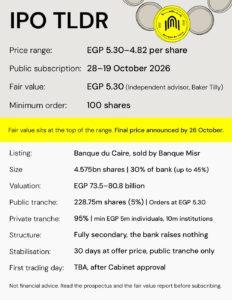
That changes this month. Banque Misr is selling 4.575 billion shares — 30% of Banque du Caire — at EGP 4.82 to 5.30 a share. At the top of the range, that values the bank at EGP 80.8 billion and the sale at up to EGP 24.2 billion, roughly three times the size of MNT-Halan’s offering. Retail gets just 5% of the shares, and the public window runs 19 to 28 October.
The number some people might miss
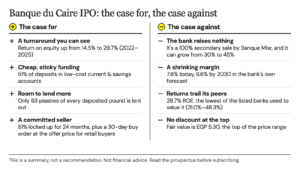
The independent financial advisor, Baker Tilly, valued Banque du Caire at EGP 5.30 a share — exactly the top of the price range. So if the book prices at EGP 5.30, there is no discount to fair value at all. At the bottom, EGP 4.82, the discount is 9.1%. MNT-Halan came in at a 5.5% discount. Where the final price lands matters more than usual here, and you’ll only know it by 26 October, two days before the public window closes.
At the top of the range, you’re paying 1.2x book value and 5.0x 2025 earnings. The prospectus puts the sector at 1.4x book.
What Banque du Caire does
It’s a full commercial bank — sixth-largest in Egypt by assets — owned 99.99999% by Banque Misr, which is itself owned by the Ministry of Finance. It makes money across five businesses:
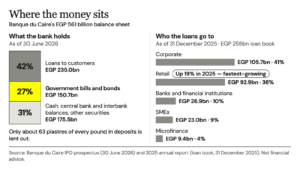
- Corporate banking — EGP 105.7bn of loans to large companies and mid-caps, plus project finance and syndications.
- Retail banking — EGP 92.9bn of personal loans (mostly backed by salary transfers), mortgages, auto loans and cards. Third-largest retail lender in Egypt, and up 19% in 2025.
- SME banking — EGP 23.0bn of loans to about 9,600 small businesses through 53 business centres.
- Microfinance — EGP 9.4bn to about 163,000 micro-entrepreneurs; a 14% share of the market.
- Treasury — the bank’s own portfolio of government bills and bonds. More on this below.
It also owns a bank in Uganda, a leasing and factoring company, an FX bureau and a payments processor, Taly — small next to a bank earning EGP 16bn. At 30 June 2026 the bank had 2,205 ATMs, about 1 million mobile-banking users and 8,238 employees. It holds about 2.5% of Egypt’s deposits and 2.1% of its loans.
Eighteen years to get here
This isn’t BdC’s first try. In 2008, National Bank of Greece bid USD 2bn for 67% of the bank — about 4.1x book — and the government said no. The shares were listed in 2017 but never traded. Offerings planned for 2020, 2022 and 2025 were shelved — by Covid, by the war in Ukraine, and by a price gap. The bank you’re being offered in 2026 is also a cleaner one: the last of the legacy portfolios Banque Misr took over in 2007 was settled in February 2026.
The strategy now is what management calls “deposit-led”: gather cheap deposits through branches outside Cairo, and lend them carefully. Low-cost current and savings accounts reached 51% of deposits in 2025, up 32% in a year. The CEO, Hussein Abaza, spent seven years running CIB before joining in 2024.
How Banque du Caire makes money
The oldest model in finance: take deposits cheaply, lend or invest them at a higher rate, keep the difference. That difference — net interest income — is 82% of BdC’s revenue.
What’s less obvious is where the money goes. As of 30 June 2026, loans were 42% of the balance sheet, and treasury bills and government bonds another 27%. BdC lends only about 63 piastres of every pound it takes in deposits; much of the rest goes into government debt, which has paid over 20% a year.
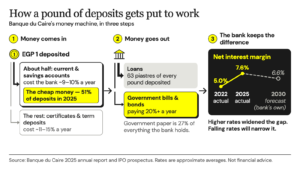
That setup has been a gift. When rates hit record highs, BdC’s cheap deposits stayed cheap while its bonds and loans repriced up. Net interest margin rose from 5.0% in 2022 to 7.6% in 2025.
It also works in reverse. The bank’s own forecast assumes treasury yields fall from 23.2% to 14.9% by 2030, and margin with them, to 6.6%. The bet is that BdC grows its loans and cheap deposits fast enough to outrun a shrinking margin.
The numbers
| EGP mn | FY2023 | FY2024 | FY2025 | H1-2026 |
|---|---|---|---|---|
| Net interest income | 18,221 | 28,729 | 34,972 | 18,792 |
| Net profit | 6,617 | 12,300 | 16,070 | 8,942 |
| Customer deposits (bn) | 303.7 | 354.7 | 404.5 | 443.9 |
| Shareholders’ equity (bn) | 33.1 | 45.7 | 62.6 | 66.8 |
| Return on equity | 23.7% | 31.2% | 29.7% | — |
| Dividends paid | 2,750 | 1,375 | 12,662 | 3,362 |
Source: BdC IPO prospectus; 2025 annual report for return on equity.
Three things stand out.
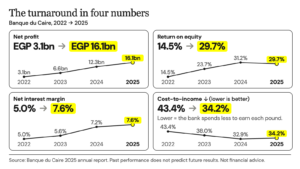
- Profit has grown five-fold in three years. From EGP 3.1bn in 2022 to EGP 16.1bn in 2025. Inflation flatters that, but a return on equity near 30% is a bank earning well on its capital.
- Ignore the headline earnings per share. Reported EPS fell in the first half of 2026 even though profit rose 21.8%, because the share count jumped from 10.25 billion to 15.25 billion after a capital increase. On today’s shares, BdC earned about EGP 1.05 a share in 2025.
- Much of 2026’s growth came from lower provisions. First-half pre-tax profit rose EGP 2.29bn; the charge for bad loans fell by EGP 2.10bn. Net interest income grew a steadier 10.7%.
The prospectus forecasts profit of EGP 18.8bn in 2026, rising to EGP 38.0bn by 2030 — about 19% a year — with return on equity holding around 26–27%.
What’s genuinely strong here
A turnaround you can see. Return on equity went from 14.5% in 2022 to 29.7% in 2025. Cost-to-income fell from 43.4% to 34.2%, so the bank now spends about 34 piastres to earn each pound. None of that came from one good year.
Cheap, sticky funding. Half of all deposits sit in current and savings accounts, which cost the bank around 9–10% against 11–15% for certificates and term deposits.
Room to lend more. With only 63% of deposits lent out, BdC doesn’t need to win new deposits to grow lending — it can shift money from government paper into loans as rates fall.
A footprint that’s hard to copy. Branches in all 27 governorates, 53 SME centres and 2,205 ATMs. Deposits outside Cairo grew 21.5% in 2025.
The seller is staying. 51% of the bank is locked up for at least 24 months, and Banque Misr has volunteered a 12-month freeze on the rest of its stake. The bank and Banque Misr have also signed agreements with several qualified investors to buy in the private tranche — names not yet disclosed.
A safety net for retail buyers in the first month. For 30 calendar days from the first day of trading, CI Capital will keep a standing buy order at the offer price, funded from Banque Misr’s own sale proceeds. Only public-tranche buyers can sell into it, up to the shares they were allocated — so if the price dips early, retail has a ready buyer at what it paid.
What to watch out for
It’s a 100% secondary sale. Every share comes from Banque Misr, so the money goes to the seller, not the bank. The prospectus is clear about why: the state’s plan, under Law 170 of 2025, to bring private capital into state-owned companies. And the offer can grow — shareholders have approved selling up to 45% instead of 30%, which would mean more supply hitting the market at once.
The margin will probably shrink. BdC earns more when rates are high and less when they fall — its own forecast says so. If lending doesn’t grow fast enough to compensate, profit growth will come in below the plan. And first-half 2026 profit was 48% of the full-year forecast, so the second half has to beat the first while rates are falling.
Its returns trail its peers. A 29.7% return on equity sounds high, but it’s the lowest among the listed banks Baker Tilly used to value BdC: ADIB Egypt 48.3%, CIB 45.9%, QNB 32.3%, Crédit Agricole Egypt 31.0%. Some of the discount to their multiples is deserved.
How to invest in the Banque du Caire IPO
Through the Thndr app, it takes about two minutes:
- Open the Thndr app and search for Banque du Caire or BQDC
- Enter the number of shares you want — minimum 100
- Make sure your account is funded before the window closes on 28 October
- Confirm your subscription
No subscription fees. As with every IPO on Thndr, we don’t charge commission on your subscription — you pay the offer price, and that’s it.=
If you don’t have a Thndr account yet, you can open one in minutes with your national ID.
What experienced IPO investors already know
Allocation is pro-rata, so size your order accordingly. If the public tranche is covered ten times, an order for 10,000 shares becomes roughly 1,000.
Fund your account early. At least 25% of your order’s value has to be in by the close on 28 October. Money that hasn’t settled in time is one of the most common reasons people miss an IPO.
You can change your mind. Public orders can be cancelled or amended until the last day — useful here, because the final price comes out on 26 October, two days before the window closes.
Read the prospectus. The fair value report and the five-year forecast the whole valuation rests on are both in it.