There’s a reasonable chance someone in your family has borrowed from MNT-Halan without ever calling it that.
Maybe it was a microloan for a small shop in Mansoura. Maybe it was the instalment plan on a washing machine. Maybe it was the green Halan card, or the e-wallet used to pay an electricity bill. Since it started, the company has put about EGP 178 billion of financing into Egyptian hands — and now it’s asking those same people to become shareholders.
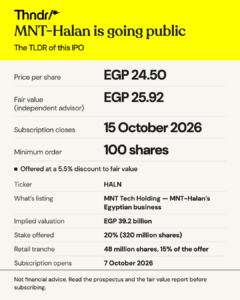
MNT-Halan is selling 320 million shares, 20% of its Egyptian business, at EGP 24.50 a share. That values the company at EGP 39.2 billion, and makes this one of the largest listings Egypt has seen in years. Retail gets 48 million of those shares, and the subscription window is 7–15 October.
The number some people might miss
The independent financial advisor, BDO, put a fair value of EGP 25.92 per share on MNT-Halan as at 30 June 2026. The offer price is EGP 24.50.
That’s a 5.5% discount to fair value — or about 5.8% of theoretical upside if the market agrees with the valuation on day one. For comparison, Korra Energi came to market earlier this year at a 7.7% discount to its advisor’s fair value.
What MNT-Halan does
Most people meet MNT-Halan through one product and assume that’s the whole company. It isn’t.
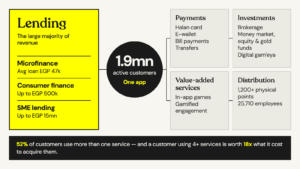
Lending is the engine, and it’s where almost all the money is made:
- Microfinance — small loans averaging around EGP 47,000, up to EGP 292,000, usually to shop owners, traders and micro-entrepreneurs. The roots go back to Mashroey in 2009, with Tasaheel added in 2015.
- Consumer finance — instalment plans and credit limits on the Halan card, up to EGP 500,000, over as much as 36 months. Launched in 2021, and the fastest-growing piece.
- SME lending — business loans and revolving overdrafts up to EGP 15 million, averaging around EGP 3.1 million a ticket.
Payments is the Halan card and e-wallet. Investments covers brokerage, a set of funds (money market, equity, gold, and Sharia-compliant versions), and a digital gam’eya run in partnership with the Agricultural Bank of Egypt inside the Central Bank’s regulatory sandbox — about 30,000 customers so far, and under 0.4% of revenue. Value-added services are the in-app games, which brought in 6.9% of new customers in the first half of 2026, up from 1.8% in 2023 (Investor Presentation).
At 30 June 2026 the group had 1.9 million active customers, 25,710 employees, more than 1,200 distribution points and a merchant network of over 5,000.
The strategy: get one product in, then sell more
MNT-Halan’s bet is that a customer who uses one product is worth far less than one who uses four. Their own numbers back it (Investor Presentation):
|
Services used |
Lifetime value per customer |
LTV / acquisition cost |
|---|---|---|
| 1 service | 5,580 EGP | 7x |
| 2 service | 7,720 EGP | 10x |
| 3 service | 12,871 EGP | 16x |
| 4+ service | 14,840 EGP | 18x |
About 52% of all customers use more than one service, and roughly 63% of newly acquired customers now take more than one product, up from 40% in 2022. Retention after year one has climbed from 28% in 2021 to 62% in 2025 — though the 2025 cohort has an incomplete twelve-month window, so the two aren’t strictly comparable.
How MNT-Halan makes money
The obvious model: borrow money from banks, lend the underserved, keep the spread.
MNT-Halan does that. But it also does something else, called offloading — and in the first half of 2026 that became its single biggest revenue line.
Offloading works like this. MNT-Halan writes a loan. Instead of holding it for until the tenure and collecting interest slowly, it packages the receivables and sells them to a bank or to investors through securitisation or a direct portfolio sale. It books a chunk of the income upfront, gets its cash back immediately, and lends it out again.
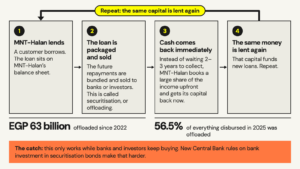
But look at what it does to the revenue mix:
| Revenue contribution | FY2023 | FY2024 | FY2025 | 1H26 |
|---|---|---|---|---|
| Interest income | 53.7% | 54.2% | 48.3% | 32.0% |
| Offloading income | 18.3% | 17.7% | 32.4% | 45.5% |
(Investor Presentation)
Offloading went from a useful supplement to the largest source of revenue. Management is explicit that it’s deliberate — monetising high-interest early instalments upfront while keeping the later ones.
The numbers
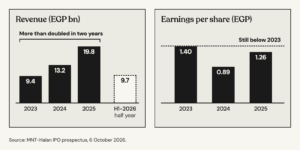
| FY2023 | FY2024 | FY2025 | H1-2026 | |
|---|---|---|---|---|
| Revenue (EGP mn) | 9,412 | 13,235 | 19,814 | 9,738 |
| Net profit (EGP mn) | 2,267 | 1,372 | 1,978 | 910 |
| Earnings per share (EGP) | 1.40 | 0.89 | 1.26 | 0.58 |
| Shareholders’ equity (EGP mn) | 6,584 | 8,607 | 9,110 | 8,539 |
Source: MNT-Halan IPO prospectus, financial disclosures section.
Three things stand out:
Revenue growth has been real. Revenue has roughly doubled in two years. The gross loan book went from EGP 23.0bn at end-2023 to EGP 46.7bn at 30 June 2026 (Investor Presentation). In an economy that spent most of that period dealing with devaluation and high inflation, that’s genuine growth, not just inflation pass-through.
But earnings per share today are lower than in 2023. EGP 1.26 in 2025 against EGP 1.40 in 2023. Profit fell hard in 2024 as funding costs repriced faster than loan yields, and the recovery in 2025 hasn’t yet got back to where it started. According to management, EPS is on its way to recovering to 2023 levels.
About a tenth of the 2026 half-year profit is a one-off. Of the EGP 910mn reported for H1-2026, EGP 91.3mn came from discontinued operations — almost entirely a EGP 119.3mn accounting gain on deconsolidating the e-commerce business. Strip it out and continuing operations earned EGP 819mn. The e-commerce entity had net liabilities of EGP 114mn when it left, so removing it was arguably good housekeeping. But it’s not repeatable, and the run-rate is the EGP 819mn.
What’s genuinely strong here
Scale that’s hard to replicate. More than 1,200 distribution points and 25,710 employees. A pure digital lender can copy the app; copying a physical network reaching cash-driven communities across Egypt takes years and a lot of money. And 61% of branch-acquired customers end up logging into the app anyway (Investor Presentation).
Market leadership. Among Egypt’s non-bank financial institutions, MNT-Halan holds roughly 63% of business lending and 24% of microfinance by loan book, and 14%+ of consumer finance by disbursements, based on FRA data (Investor Presentation).
The market is genuinely underpenetrated. Only 10.6% of eligible Egyptians have borrowed from a formal financial institution, against 43.8% in Turkey and 47.5% in Brazil. Egyptian household debt is 8% of GDP; India’s is 42% (Investor Presentation).
It provisions more than it has to. At 30 June 2026 the company carried EGP 1.34bn of expected credit loss provisions against the EGP 0.91bn the FRA’s standards require — about 47% more than the regulatory minimum. Non-performing loans were 1.5% of the book with coverage of 384% (Investor Presentation).
Most of the company is locked up. Roughly 51% of the share capital is frozen for at least 24 months, well above the 25% the listing rules demand. On top of that, the EGM approved a voluntary 12-month freeze on all remaining unsold shares and on the new shares from the capital increase. The selling shareholder is not heading for the exit.
Serious institutional backing. MNT Investments B.V., the Dutch parent, is 42.9% owned by GB Capital — which traces up to GB Corp, itself listed on the EGX — and 20.8% by a vehicle whose ultimate beneficiary is International Holding Company (IHC), listed in Abu Dhabi. The IFC and EBRD are also investors in the group. Note these sit at the parent level, not on the register of the Egyptian entity you’d be buying.
There is a stabilization fund. For the first 30 calendar days of trading, there’s a standing buy order at EGP 24.50 — the offer price — funded with 100% of what retail investors paid in. If the shares trade below that in the window, anyone who subscribed in the public tranche can sell back at EGP 24.50; private-tranche buyers can’t.
What to watch out for
The loans aren’t secured on anything you can seize. The prospectus is blunt: the portfolio relies heavily on commercial paper and promissory notes rather than physical collateral, these do not constitute security over assets, they give no recourse to specific borrower assets, and enforcement requires going through the courts. For a book of EGP 31.6bn of facilities outstanding at 30 June 2026, that’s the central credit question.
Credit losses have slightly stepped up, largely reflecting the impact of the macroeconomic shocks experienced over the past few years, including elevated inflation, currency devaluation and higher interest rates, which placed pressure on borrower affordability and repayment capacity. As macroeconomic conditions stabilize, management expects credit losses to normalize, with current guidance reflecting a prudent approach to provisioning as the portfolio continues to grow.
Regulation is tightening on several fronts at once. Unified solvency standards take effect 1 January 2027. New CBE payment-service-provider licensing rules landed in June 2025. The Central Bank has tightened what banks may hold in securitisation bonds — higher risk weights, tighter single-obligor limits — which squeezes the channel generating 45% of first-half revenue.
Selling loans doesn’t end the exposure to them. The prospectus gives offloading a risk factor of its own, and the mechanism is worth understanding. Securitisation programmes come with reserve accounts that MNT-Halan must keep funded to support the cash flows on portfolios it has already sold. If those loans start performing worse than assumed — higher defaults, slower collection — the company has to top those accounts up. The prospectus spells out what follows: less liquidity to fund new lending, fewer resources for operations, and a lower economic return on the offloading itself. A deterioration in loans that left the balance sheet still reaches back and constrains the business. The same risk factor notes that a credit rating downgrade, by MERIS or another agency, would reduce investor appetite and raise the cost of future issuances.
If offloading stalls, the cash flow runs backwards. This is the scenario the prospectus describes most vividly, and it’s the one worth understanding properly. MNT-Halan collects repayments on loans it has already sold and passes that money to the investors who bought them. That works as long as new offloading deals keep closing, because new proceeds fund new lending. But if deals stall — because eligible receivables run short, because regulatory approvals are delayed, or simply because banks and investors are short of liquidity — then, in the prospectus’s own words, a large proportion of incoming cash gets directed toward settling existing offloading obligations instead of originating new financing, until alternative funding is found. The balance sheet already carries a version of this: restricted cash held against offloaded receivables rose from EGP 0.7bn at end-2023 to EGP 8.9bn at 30 June 2026 (roadshow materials). That’s cash the company holds but can’t freely deploy.
The margin story runs in both directions. MNT-Halan lends at fixed rates and borrows substantially at floating ones — its bank facilities reprice with the central rate, while loans are priced for the life of the loan. On the way down that’s a tailwind, and the company presents it as one: as the Central Bank cuts, funding costs fall immediately while the existing book keeps earning its locked-in yield. The guidance assumes exactly that, with the CBE lending rate falling from 25% toward 12–10% over the medium term (roadshow materials). But the prospectus states the other half plainly — it cannot reprice existing financing before maturity, whereas any increase in funding cost is reflected immediately. So if the easing cycle stalls or reverses, the same mechanism compresses margins rather than expanding them. For a net energy importer like Egypt, an oil price shock driven by regional tension is the classic trigger: energy costs feed into inflation, inflation stops the rate cuts, and the spread narrows. And the prospectus names inflation and rising interest rates among the macro factors that directly worsen customer credit quality — so a rate shock would hit twice, on the spread and on the borrower.
The TLDR of this IPO
- What’s listing: MNT Tech Holding for Financial Investments — MNT-Halan’s Egyptian business. Ticker HALN.
- Offer price: EGP 24.50 per share
- Fair value per the independent advisor: EGP 25.92 — a 5.5% discount
- Size: 320 million shares, 20% of a 1.6 billion share capital
- Implied valuation: EGP 39.2 billion
- Public tranche: 48 million shares (15% of the offer), minimum 100 shares, no maximum
- Private tranche: 272 million shares (85%), minimum EGP 5 million for individuals, EGP 10 million for institutions
- Public subscription: 7 October to 15 October 2026
- Private subscription: 7 October to 12 October 2026
- Allocation: pro-rata if oversubscribed — no ballot, no guaranteed minimum
- Stabilisation: 100% of public tranche proceeds (~EGP 1.18bn), at EGP 24.50, for 30 calendar days, public tranche only
- Book runner: EFG Hermes · Independent financial advisor: BDO · Auditor: KPMG
- Cornerstone: CIB, up to 4.9% of the company, with the right to nominate a board member
- First day of trading: to be announced by the EGX
How to invest in the MNT-Halan IPO
Through the Thndr app, it takes about two minutes:
- Open the Thndr app and tap on the IPOs section
- Select the MNT-Halan IPO
- Enter the number of shares you want — minimum 100
- Make sure your account is funded before the window closes on 15 October
- Confirm your subscription
No subscription fees. As with every IPO on Thndr, we don’t charge commission on your subscription — you pay the offer price, and that’s it.
If you don’t have a Thndr account yet, you can open one in minutes with your national ID.
What experienced IPO investors already know on
Allocation is pro-rata, so size your order accordingly. If the public tranche is oversubscribed, every order gets scaled back by the same proportion. There’s no ballot and no guaranteed minimum — if the tranche is covered five times, an order for 1,000 shares becomes roughly 200.
Fund your account early. Brokers must deposit at least 25% of each order’s value with the clearing banks before the window closes. The single most common reason people miss an IPO is money that hasn’t settled in time.
You can cancel. Public-tranche orders can be withdrawn right up to the last day of the subscription period.
You can’t do both tranches. Anyone buying in the private tranche is barred from also placing a public-tranche order.
Read the prospectus and the fair value report. They’re published for a reason, and in this case the fair value report contains the forecast the entire valuation rests on.
All investment involves risk. The information contained on this page is not financial advice. You should always do your own research before making any investment decisions. The Thndr platforms and brand name are the property of Axis Markets BV. Trading is done through our regulated entities: Thndr Securities Brokerage in Egypt, regulated by Egypt’s Financial Regulatory Authority, and Thndr Financial Ltd, regulated by ADGM’s Financial Services Regulatory Authority.